As a result of the intensive construction work on the Kremlin, Moscow came to be known as the "white-stone
city". Construction was carried on against the background of struggles with the Golden Horde, Lithuania and rivalry with Tver.
Before long the new Kremlin successfully repulsed attacks of the armies of Grand Prince Olgerd of Lithuania (in 1368 and 1370).
True, in 1380-1382 Khan Tokhtamysh attacked Moscow and with a ruse broke into the Kremlin; but the citadel, and the rest of the
city, was soon rebuilt. By the end of the 14th century, the Kremlin was tightly packed with various structures. The whole of its
grounds was covered with churches, monasteries and manors of the Grand Prince's retainers, top military men and rich merchants.
The 15th century was marked by further growth of Moscow's political and military might.
By the end of the 15th century, the unification of the Russian feudal principalities under the authority of Moscow was, in
the main, completed. A single Russian state had been formed. Grand Prince Ivan Ill of Moscow became the Grand Prince of All Russia.
The Kremlin
Ivan Ill launched reconstruction of the Kremlin on a grand scale, having invited a number of noted master builders from
Italy for the purpose. At the time, Italian builders were recognized as the best in Europe. And, so, alongside builders from
Pskov, Novgorod and Vladimir who had come to the capital on the orders of the Grand Prince to take part in the construction of
the city, the Italian architect and military engineer Aristotile Fioravanti arrived in Moscow together with his son Andrea and his apprentice Pietro.
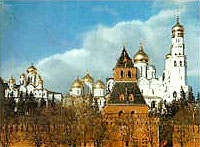
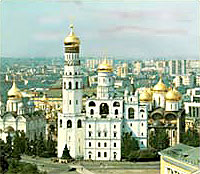
The new Cathedral of the Dormition (1475-1479) was the first to be built. In 1484-1489, the festive Cathedral of the Annunciation was erected next to it. Subsequently, in 1505-1508, they were joined by the Cathedral of the Archangel. This is how the remarkable ensemble of Cathedral Square; the oldest square in Moscow, with its three cathedrals and the snow white Bell Tower of Ivan the Great took shape. Still another adornment of the square is the Palace of Facets, the formal reception room of the Grand Prince's palace. This was built by Perco Ruffo (Fryazin) and Pietro Antonio Solari (Pyotr Fryazin) from 1487 to 1491. At the turn of the 16th century, the Kremlin was practically completely renovated; at the time, new Kremlin walls were built in parallel with the construction of the palace and the cathedrals. For a whole decade, starting from 1485, the dilapidated white-stone walls and towers were gradually pulled down and replaced with new ones. The construction work was supervised by Italian architects.
The new Cathedral of the Dormition
It was then that the Kremlin acquired its present-day outlines.
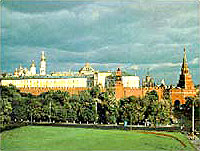
The fortress walls, forming an irregular triangle, are 2,235 m long, from 3.5 to 6.5 m thick and from 5 to 19 m high. Atop the walls stand 1,045 bifurcated merlons, from 2 to 2.5 meters in height and fitted with narrow embrasures. Behind the merlons and running inside the wall is a combat platform from 2 to 4 meters wide. Along the east Kremlin wall facing what is now the Red Square moat, 12 m deep and 32 m wide, which was dug and filled with water.
On its northwest side Borovitsky Hill was protected by the Neglinnaya River and on its south side, by the Moskva River. Thus, the Kremlin fortress was surrounded by water on all sides like an island and could be entered only by way of drawbridges. The Kremlin was a superb example of the fortification art of the period.